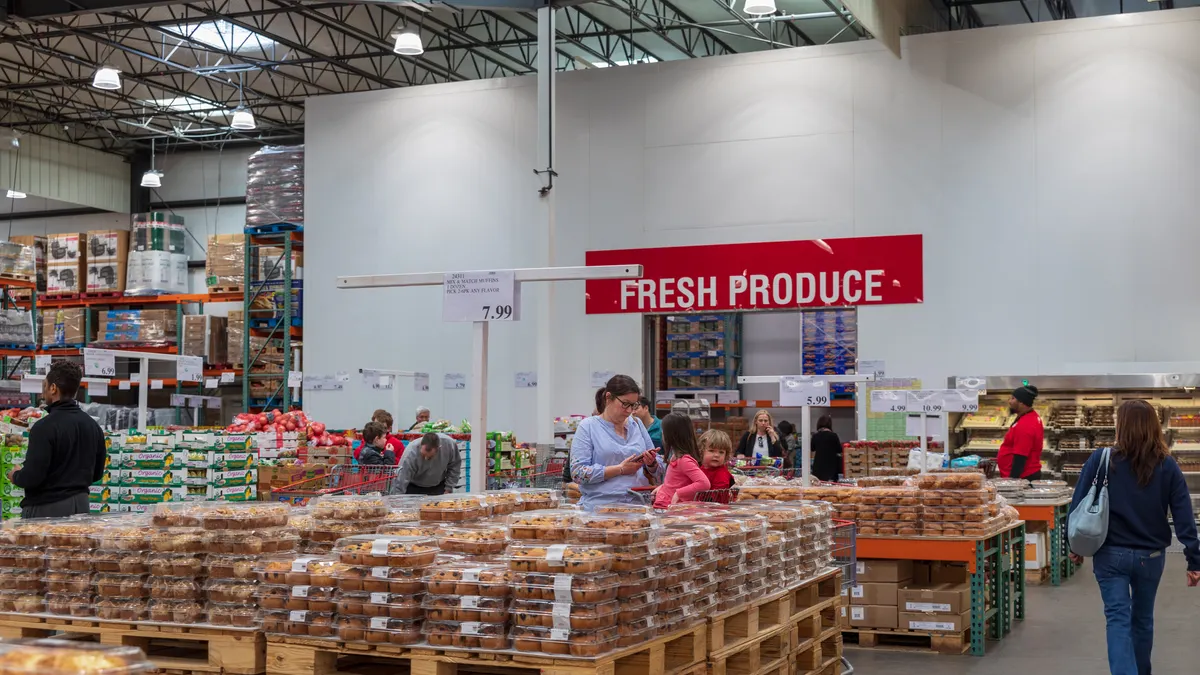
Club retailers’ combo of discounted prices and grocery assortments is packing a powerful one-two sales punch in their battle against traditional grocers.
In recent earnings calls, club retailers outlined how their focus on value is helping them stand out to consumers. At the same time, club stores are growing their presence around the U.S., bringing new competition to the backyards of regional and independent grocers.
BJ’s Wholesale Club made “considerable investments in value during the [fourth] quarter in our grocery business and we will continue to do that in the future,” Robert Eddy, the company’s president, CEO and chairman, told investors earlier this month.
The club retailer’s perishables, grocery and sundries division grew comparable sales by 2.3%, thanks to strong performance in the perishables department, nonalcoholic beverages, candy and snacks. BJ’s sales growth in fresh comes roughly a year after the retailer’s chainwide launch of its Fresh 2.0 initiative, which overhauled its produce, meat and seafood departments.
“These results reinforce the importance of our core consumables franchise, which continues to demonstrate consistency, even in a volatile operating environment,” Eddy said.
During its most recent quarter, Sam’s Club’s grocery sales and general merchandise led its overall sales growth. Both the fresh, frozen and refrigerated category and the beverage and grocery category saw mid-single-digit comp sales growth during the quarter, which ended Jan. 31.
In its second quarter, Costco saw fresh comparable sales rise in the low double digits, led by meat and bakery. Its food and sundries comps grew mid-single digits, led by candy and packaged foods.
“In meat, we saw strong growth in both premium cuts of beef and lower-cost proteins such as ground beef and poultry. In bakery, we continue to see success with the launch of exciting new items like the chocolate hazelnut mini beignets and a variety of seasonal pastries and cookies,” Costco CFO Gary Millerchip said on the earnings call earlier this month.
The retailer is looking to drive value and be “a pricing authority” by lowering prices on key items like eggs, cheese, coffee and some paper products, Costco President and CEO Ron Vachris said. Costco expects to see significant unit and market share growth in eggs because of the retailer’s strong value proposition, Millerchip said.
According to a Grocery Dive analysis of Numerator data last fall, Costco made one of the strongest grocery market share gains over the past several years, jumping from a 7% share in the 2020-2021 period to an 8.4% share in the 2024-2025 period.
Private label plays a key role in attracting grocery consumers to Costco. During the second quarter, the retailer added approximately 30 new Kirkland Signature items, including crispy wings and blackened salmon, and offered steep discounts on several Kirkland Signature items, including:
- $5 off 2-liter Italian extra virgin olive oil, to $24.99
- $1.80 off 12-count organic coconut water, to $10.99
- $1 off organic seaweed, to $9.99
At BJ’s, private label accounted for 27% of merchandise sales in fiscal 2025 and the retailer is looking to grow that to 30%.
This focus on value is playing into consumers’ food affordability concerns. Costco “used to be a place where people would go for their bulk purchases, not their everyday grocery shopping, but what I've noticed is, A, the parking lots are full. B, the stores are full, but also people are shifting their dollars to buying in bulk in order to save money,” Lorin Drake, consumer insights strategist with Publix, said during a recent virtual event hosted by Dunnhumby.
Drake noted that the former reputation of club retailers as a stock-up shop for grocery items like bottled water has now shifted to one where consumers see them as places to trim their grocery bills.
“The entire household is … buying massive boxes of cereal, because that's how they save money, so their answer to the affordability crunch is to buy in bulk for everyday grocery shopping at Costco,” Drake said.
Growing store fleets
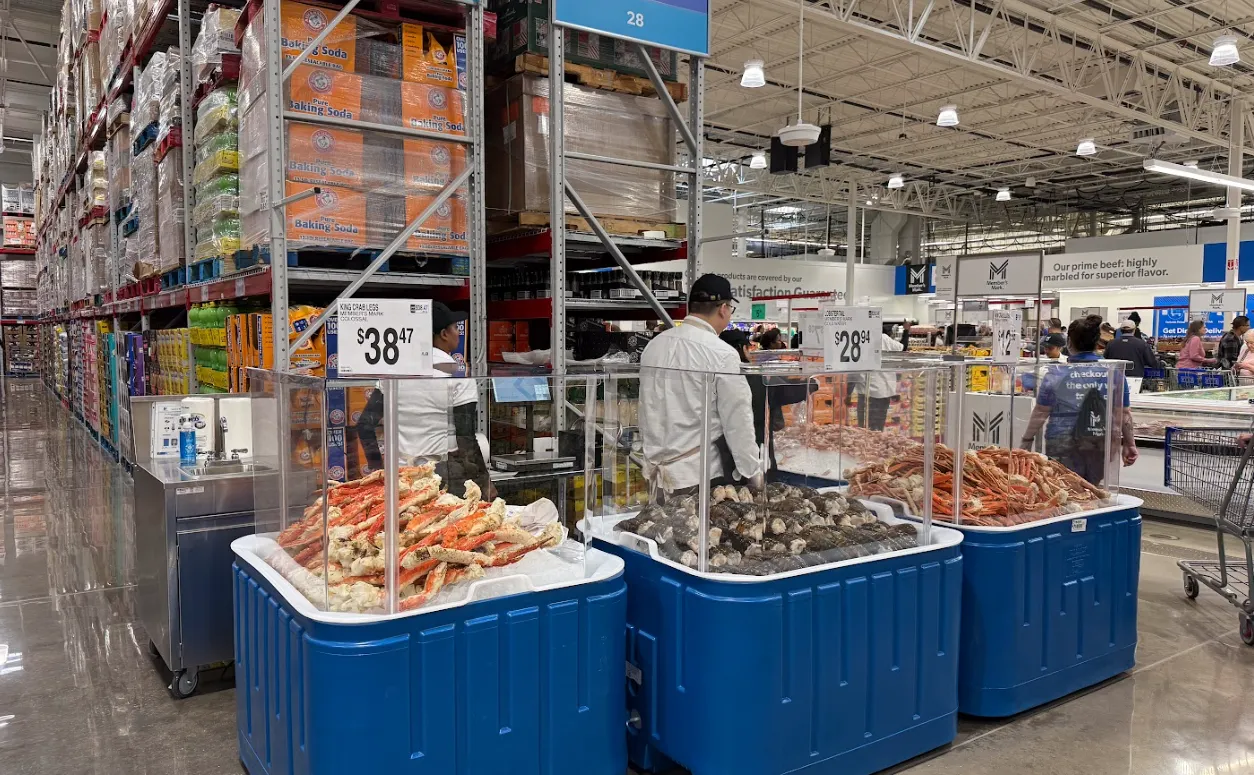
Club retailers are also expanding their presence across the U.S. — ratcheting up the competition against neighboring grocers.
Walmart hasn’t been shy about its ambitions to supercharge Sam’s Club growth. The company plans to double the club’s membership and more than double its sales and profit in less than 10 years. Last year, Walmart announced plans to open approximately 15 new clubs each year for the next decade and remodel 600 existing Sam’s Club locations. A new store format it has been testing in Grapevine, Texas, that features a “sushi island” and other meal displays along with service departments like pharmacy, will serve as the new model going forward.
Meanwhile, Costco recently opened two warehouses in the U.S. and expects to have 28 net new openings globally in fiscal 2026, followed by 30-plus per year going forward, company executives told investors in March.
BJ’s opened 14 clubs in fiscal 2025 — the most locations it’s debuted in a single year — and the retailer is on track to meet its pledge of opening 25 to 30 new clubs over 2025 and 2026, company executives told investors earlier this month. “As we look out at the new club pipeline, we would expect this pace of openings to continue over [the] coming years,” Eddy said on the earnings call.
In January, BJ’s welcomed its second BJ’s Market, a grocery-focused format that is smaller than its usual clubs, in Delray Beach, Florida.
“Our advantage structure allows us to consistently deliver meaningful savings up to 25% better than traditional grocery, and we are relentless about maintaining that edge for members,” Eddy said. “This commitment to value is one of the reasons we continue to see steady renewal rates, strong traffic and healthy unit growth in our core businesses.”
Jeff Wells contributed reporting